Ohreems Greencell Tech · Battery recycling
Battery recycling.
A more circular future.
We recover critical mineral rich Black Mass from end-of-life lithium-ion batteries at our facility in Harohalli, Karnataka, and supply it as feedstock to refining partners.
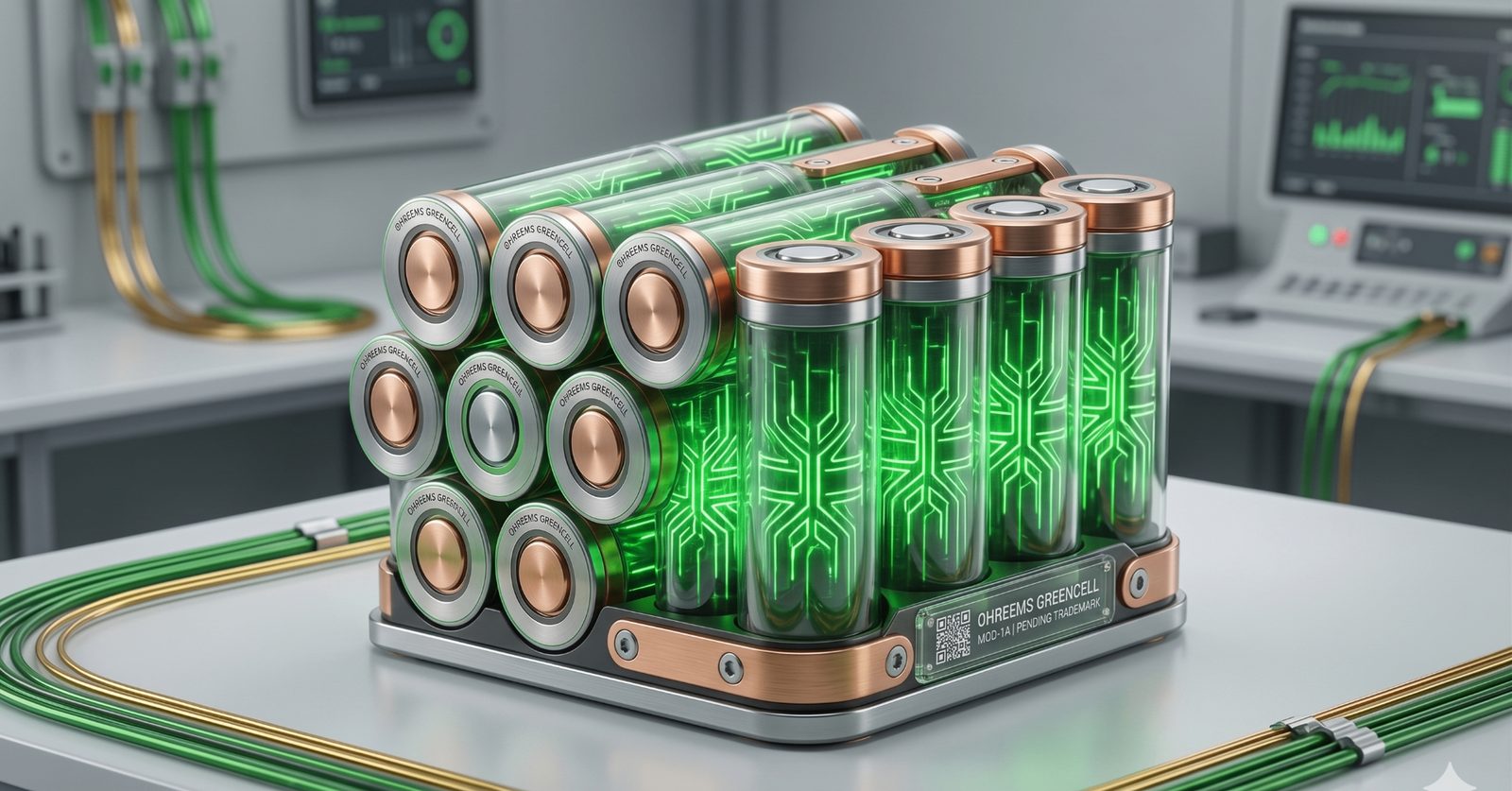
What we do
End-to-end battery recycling capabilities
Black Mass production
Mechanical pre-treatment converts end-of-life battery scrap into high-purity black mass, preserving critical materials.
Nickel · Cobalt · Lithium content
Industrial safety
Inert-gas shredding chambers and dust-capture pipelines for controlled processing.
Inert-gas · Dust-capture
Environment-safe operations
Closed-loop water systems and operations aligned with EPR frameworks.
EPR framework
Downstream feedstock supply
Screened, quality-tested black mass packaged as uniform feedstock for hydrometallurgical refining partners.
Battery-grade feedstock
Our process
From spent cell to Black Mass, in four stages
- 1
Collection & intake
Batteries collected from OEMs, fleet operators and recyclers.
More detail
Each batch is logged and assessed on arrival.
- 2
Safe discharge & dismantling
Cells safely discharged and separated by chemistry type.
More detail
Separation by chemistry enables targeted downstream processing.
- 3
Shredding & black mass recovery
Mechanical shredding under inert atmosphere.
More detail
Yields black mass with minimal contamination.
- 4
Feedstock distribution
Black mass screened, quality-tested and packaged.
More detail
Delivered as uniform feedstock to hydrometallurgical refining partners.
Live on Ohreems Recycling ERP
Greencell Tech Pvt Ltd is live on Ohreems Recycling ERP
Our Harohalli operations run on Ohreems Recycling ERP — connecting batch intake, processing, black mass inventory, quality and dispatch with end-to-end traceability in one system.
Facility & capabilities
Ohreems Greencell, Harohalli
- Facility location
- Harohalli Industrial Area (KIADB 1st Phase), Kanakapura, Bengaluru, Karnataka
- Supported materials
- End-of-life lithium-ion batteries and battery scrap
- Processing scope
- Collection, discharge, dismantling, mechanical shredding and black mass recovery. Refining is carried out by downstream partners.
- Traceability approach
- Every incoming batch is logged and assessed on arrival and tracked through processing in Ohreems Recycling ERP.
Ready to close the battery loop?
Talk to us about battery collection, recycling partnerships or Black Mass supply.